TAU Innovations / Retovian
At TAU Investment Management, I led TAU Innovations and developed Retovian, a working production-tracking and supply-chain transparency product. We replaced paper-based factory records with simple tablet inputs over 3G and dashboards for production visibility. Field research in Southeast Asia and Africa connected productivity, item provenance, and the information needs of factory owners and brands.
"How could a supply-chain product help people understand productivity and item provenance while remaining usable in environments with limited connectivity and little prior tablet experience?"
My responsibility
Head of TAU Innovations · Lead Product Designer (2013–2016) — led field research and product development, connecting productivity and provenance needs with practical interfaces and technical constraints.
Judgment & tradeoffs
Decisions and why
01
Replace paper at the point where work happened
The factories we studied relied on paper records. I prioritized a simple production-line tablet interface that workers could use during the work itself, over a 3G connection. Digital inputs fed a dashboard so factory owners could see production activity without relying solely on paper aggregation.
02
Develop the product inside its operating environment
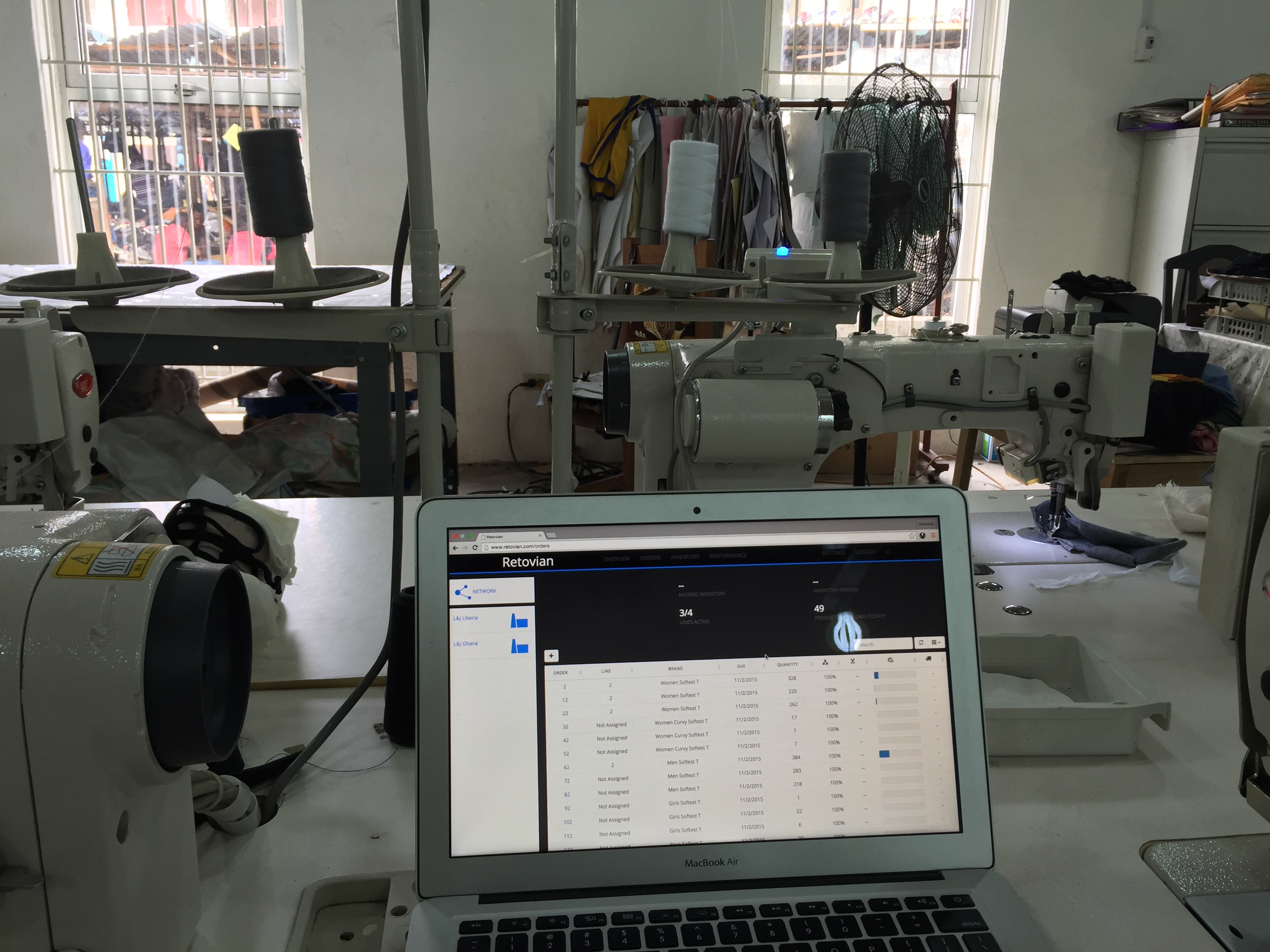
I worked and coded alongside women on the factory floor. That proximity connected the interface to actual production routines, limited connectivity, and people with little tablet experience. The laptop dashboard and tablet inputs shown here were built and operating in an African factory.
03
Separate the deployed product from exploratory technology
TAU Innovations also tested sensor applications in Bangladesh and explored blockchain for provenance. These were experiments within the innovation hub, not fully implemented components of the Retovian deployment. I kept the delivered product focused on usable digital inputs and production visibility.
From discovery to provenance
Industry innovation discovery guided field research into factory operations and supply-chain information needs. The research informed three innovation pathways: location-tagged live sensor audit data, blockchain contracts, and an operational transparency platform. The pathways converged on field testing and the goal of understanding singular item ESG impact and provenance across the chain. Retovian’s operational platform was deployed; sensor and blockchain work remained exploratory.
- 1Production-line tablet inputs over 3G
- 2Factory-owner production dashboard
- 3Inventory, orders, and provenance planning
- 4Field research and on-site development
Shaping the Experience
The factories we studied operated through paper records: production quantities, material information, and test reports lived on sheets and cards. The challenge was to capture useful information digitally without imposing an interface that got in the way of production. I built a simple tablet interface for production-line tracking over a 3G signal, connected to a dashboard for factory owners. I worked and coded among the women on the factory floor, refining the product within the environment where it would be used. The photographs show Retovian after it was built and operating. The planning extended across inventory, orders, manufacturing stages, and item provenance: how materials and their origins could remain connected to products and become useful information for brands further along the chain. As an innovation hub, we also tested sensor devices in Bangladesh and explored blockchain. Those experiments were not fully implemented in the deployed product. The delivered Retovian experience centered on digital worker inputs and production visibility.
In practice
Photographs and artifacts from the work. Select a photograph to view it in full.
- 01
Built and operated Retovian’s tablet production-tracking interface and factory dashboard in an African factory.
- 02
Replaced paper-based production inputs with a simple digital interface designed for a 3G connection.
- 03
Connected field research on production and item provenance with the information needs of factory owners and brands.
- 04
Tested sensor applications and explored blockchain as separate innovation experiments; these were not fully implemented in the Retovian deployment.