Knowledge Discovery — Ford Foundation
Helped grantmakers discover themes and relationships across institutional knowledge. Combined research, information architecture, search redesign, and workflow improvements to increase adoption tenfold, and partnered with visiting Google researchers to evaluate machine learning and semantic search.
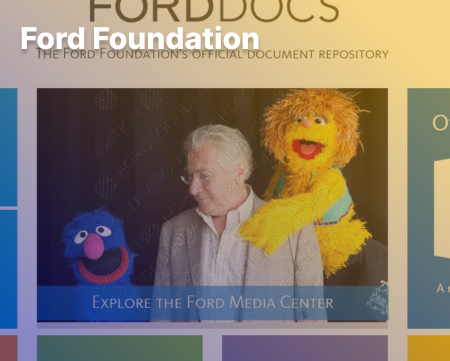
"Institutional knowledge was trapped in siloed legacy repositories. The challenge was preventing 'organizational amnesia' by transforming 80 years of unstructured PDFs and grant letters into a searchable, semantic database without overwhelming non-technical Program Officers."
My responsibility
Information Management Specialist · Product and UX Design — stakeholder research, information architecture, search redesign, and technology adoption.
Judgment & tradeoffs
Decisions and why
01
Support discovery beyond keyword search
I designed taxonomy, facets, and discovery workflows to help grantmakers understand what grants were about and find relationships across institutional knowledge. I partnered with visiting Google researchers to evaluate machine learning and semantic search, translating the possibilities into tools for nontechnical staff.
02
Make adoption part of the transformation
Research and workflow improvements were accompanied by training workshops. The goal was to make institutional knowledge usable in daily work, contributing to a tenfold increase in adoption.
How it Works
A unified knowledge retrieval architecture. We consolidated disparate SQL databases and file servers into a single search index. The pipeline utilized NLP entity extraction to automatically tag documents with 'about-ness' (themes, regions, demographics), enabling semantic retrieval across decades of unstructured text.
- 1Taxonomy & Metadata Schema
- 2Entity Extraction Logic
- 3Intranet/SharePoint as Semantic Search Frontend
- 4Grantmaking data ingestion pipeline
Shaping the Experience
Designing for 'Sense-Making,' not just search. I moved beyond simple keyword matching to design a faceted discovery interface. The UX introduced 'Topic Clusters' and 'Smart Filters' that allowed officers to drill down by era, grant type, or impact region, reducing the cognitive load of sifting through legal archives.
- 01
Consolidated 4 disparate legacy repositories into a Single Source of Truth for grant history.
- 02
Reduced document retrieval time for Program Officers by introducing NLP-driven semantic facets.
- 03
Recovered "lost" institutional knowledge by digitizing and tagging 80 years of physical and digital artifacts.
- 04
Brought about cross-departmental alignment on knowledge management best practices.