ChalkNotes
A mixed‑reality audio‑AR platform that lets creators drop stories onto real‑world maps and audiences discover them. Relaunched in 2026 as Emily Was Here, a lightweight white-label version of the same idea.
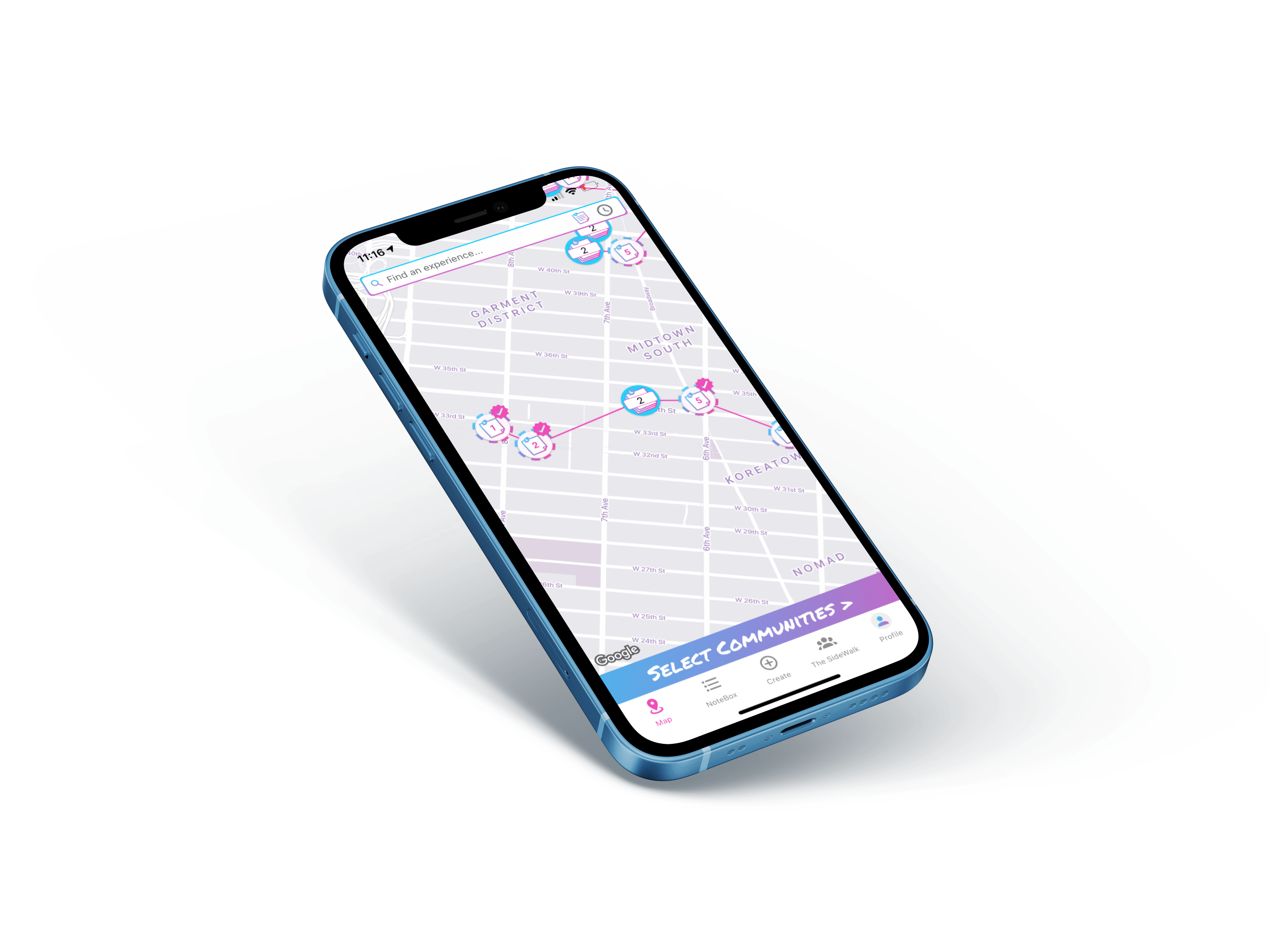
"Visual AR demands too much attention. The business problem was creating a 'Heads-Up' engagement model that allowed users to consume content while navigating busy city streets."
My responsibility
Lead Product Designer, UX Strategist, Engineer Manager. Owned end‑to‑end design across no‑code authoring and mobile discovery. Led research, prototyping, and usability testing with creators and audiences in uncontrolled real‑world environments.
Judgment & tradeoffs
Decisions and why
01
Use audio to reduce screen dependence
Field research and usability testing informed an audio-first experience with high-contrast controls. The resulting interaction model reduced screen time by 60% while people explored real places.
02
Design location triggers for real-world uncertainty
I used broader audio geofences rather than requiring precise visual anchors. This accounted for GPS drift and made the interaction less dependent on someone holding a phone in exactly the right position.
How it Works
A geospatial audio engine that triggers sound based on GPS radius, utilizing a React Native frontend and a Firebase real-time backend for creator updates. A dual-client ecosystem: a React Native mobile app for geospatial discovery and a React web dashboard for creator administration. The system relies on Firebase NoSQL for real-time authentication and state sync, integrating a web3 'XP' gamification layer to drive physical foot traffic via tokenized collectibles.
- 1Location-based audio triggers on mobile map.
- 2No-code web authoring tool for spatial story placement.
- 3Content discovery feed with experience previews.
- 4Community engagement features (sharing, reviews).
Shaping the Experience
The core design challenge was 'Heads-Up' usability. I moved the primary interaction controls to the bottom third of the screen (thumb zone) and designed high-contrast, bold typography that remains legible in direct sunlight. The 'Audio Radar' visualization gave users directional feedback without requiring map literacy, solving the 'blue dot' anxiety common in GPS apps. Below is the augmented reality element activation. Instead of relying on visual markers alone, I designed an audio-centric interface where users hear spatial cues as they approach points of interest. The UI provides subtle visual feedback, but the primary interaction is auditory, allowing users to stay aware of their surroundings while engaging with content.
- 01
Validated an 'Audio-First' AR interaction model, reducing screen-time during the experience by 60%.
- 02
Shipped a 'No-Code' spatial authoring tool allowing creators to place audio without technical skills.
- 03
Solved for GPS drift by designing broad 'Audio Geofences' rather than precise visual anchors.
- 04
Delivered a seamless user experience that balanced engagement with safety in urban environments.
- 05
Codified best practices for mixed‑reality experience design in open, unpredictable environments.