Agentic Board Intelligence
An agentic decision-support product that reads dense board decks and surfaces the story executives need in order to act. I led the human-AI interaction layer through five UI iterations, from a text-heavy first version to a grounded, chunked, collaborative interface. Client is under NDA: company name and client data are withheld, and screens are cropped to remove identifying details.
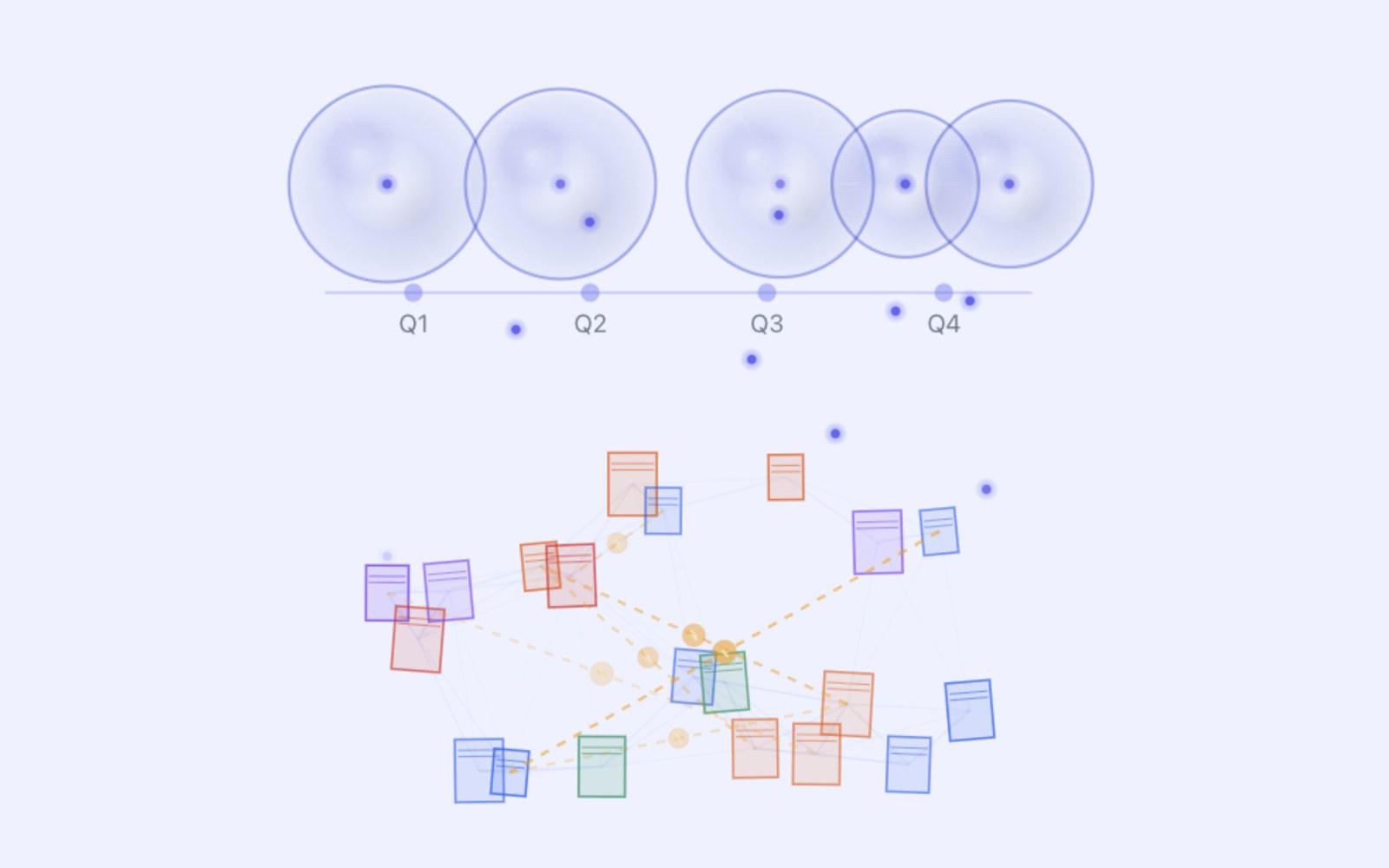
"A board deck is 80-plus pages of text, tables, and charts. Executives don't want a summary; they want the story, and they need to trust it. The failure modes are opposite and both fatal: over-trust (act on a hallucination) or under-trust (ignore the tool). When I joined, the product had no references, no confidence signals, and an interface that buried findings in prose. The challenge was an interaction layer that brings people closer to the narrative inside the data while keeping every claim grounded and contestable."
My responsibility
AI Interaction Design Lead (contract, Jan–May 2026). Owned the interaction model between executives and the agent: research, information architecture, trust cues, transparency patterns, and five rounds of UI iteration driven by founder and user feedback. Also designed the investor deck and marketing site.
Judgment & tradeoffs
Decisions and why
01
Make AI findings inspectable
I moved the interface from a wall of generated prose to findings revealed in layers, with source attribution and confidence cues. Founder and user feedback showed that people needed to understand where a claim came from before acting on it.
02
Let people revise the findings
I designed the conversational side panel to change the results, rather than only answer questions about them. This kept the executive involved in shaping the data without altering the story, commit their own time sensitive information, and made the AI’s output something they could question and refine.
How it Works
A retrieval-grounded agent over uploaded board decks. I designed the interaction layer, not the model: how extracted facts are scored, surfaced, sourced, and revised through conversation. Details of the underlying system are withheld under NDA.
- 1Chunked, narrative-first results: the story on top, evidence one click below, raw extracted facts below that.
- 2Grounding: every derived fact carries a reference to its source in the deck and can be clarified in place.
- 3Confidence scoring on the upload and analysis flow, replacing an open process with no signal of reliability.
- 4A MECE information architecture replacing an overlapping category model that made results hard to navigate.
Shaping the Experience
The first version I inherited was a wall of words. Findings were correct but unreadable, nothing cited a source, and the navigation model overlapped with itself, so executives could not build a stable mental model of what the product had done with their deck. Feedback from founders and users pointed the same direction: people wanted to know where a claim came from before they would act on it. Across five iterations the interface moved from prose to structure. Findings are revealed in chunks, ordered by the story they tell, with the underlying facts one layer down and their source passages one layer below that. I introduced trust cues at each level: a confidence score on every extracted fact from the moment of upload, source attribution on every claim, and an explicit path to clarify anything that looked off. The navigation was rebuilt to be mutually exclusive and collectively exhaustive, so the same finding never appeared under two headings. The last major addition was a side-panel collaborator. Earlier versions treated chat as a way to ask questions about the results. I redesigned it as a way to change them: an executive could say "treat the Q3 forecast as provisional" and watch the results update. That shifted the product from a chatbot with a report attached to a mixed-initiative tool where the human and the agent revise the same artifact together.
- 01
Replaced a dense, text-heavy results view with an organized layout that reveals findings in chunks, so executives read the story first and the evidence on demand.
- 02
Introduced source attribution where none existed: every derived fact links back to its origin in the deck, and can be clarified at any point.
- 03
Redesigned the upload and analysis flow with confidence scoring, so users could see how solid each extracted fact was before acting on it.
- 04
Replaced an overlapping, non-MECE navigation model with a cleaner mental model of how the product organizes what it found.
- 05
Designed a side-panel collaborator that edits the results as you talk to it, a mixed-initiative pattern rather than a bolt-on chatbot.